

Postgraduate studies and research are critical components that enhance the prestige and reputation of Olabisi Onabanjo University as a world-class institution. The postgraduate school prides itself on creativity, innovation, interdisciplinary research, consultancy, effective partnerships and hybrid graduate programmes. We advocate excellence in all areas of scholarship with all stakeholders and make transformative discoveries that impact the nation and the world.
The Postgraduate School was conceived as a hub of total training for postgraduate students, which is central to the academic mission and vision of the University and a major step towards the pursuit of educational goals. The principles for establishing the school are in tandem with the statutes that set Olabisi Onabanjo University, Ago-Iwoye, as conceptualised by its founding fathers.


Our History
The genesis of postgraduate education at Olabisi Onabanjo University can be traced to the 1989/1990 session when the Department of Educational Foundations and Management in the Faculty of Education admitted 22 students for the Masters in Educational Management programme, followed by the Postgraduate Diploma in Education programme in the 1991/1992 session.
In the 1992/1993 session, the College of Agricultural Sciences commenced its Diploma programme in Agricultural Extension, while the Faculty of Social and Management Sciences began Diploma and Masters programmes in Transport Studies (based in the Department of Geography and Regional Planning). The Faculty of Social and Management Science MBA programme commenced in the 1995/1996 session.
Our Vision
To provide courses of instruction and other facilities to pursue high-quality Postgraduate programmes throughout the University to all persons irrespective of race, creed, sex or political conviction and consequently provide the general society with the needed high-quality human resources.
Our Mission
To be the best Graduate School in Africa and primus inter pares globally, and lead the University to achieve the highest excellence in staff, research, consultancies, academic content, and graduates through cutting-edge research. To employ up-to-date data acquisition, information analysis and knowledge delivery systems.
Upholding the vision and mission
The postgraduate school is working tirelessly to uphold the institution’s vision and mission at all stages.
- Flowchart for the Award of Masters and Ph.D: A full-time Ph.D. or MPhil/Ph.D. runs for three years, while a part-time Ph.D. or MPhil/Ph.D. runs for four years.
- There are some evaluation forms designed to monitor progress of research students for quality assurance.
- The RPMS is in place for the prompt processing of results.
- The Postgraduate school holds annual research week and symposia for research students.
Our Philosophy
Seeks to provide world-standard academic and professional knowledge that will enable students to compete favourably with counterparts worldwide. Students are encouraged to cultivate a worldview that facilitates the continuous pursuit of academic and moral excellence and develop their expertise and competence in reducing society’s problems.
Admissions
- Full-time admission: this is offered only to candidates who satisfy the postgraduate school that they are not in employment or undertaking full-time studies elsewhere.
- Part-time admission: candidates may be admitted to part-time registration if they are staff of the university or can satisfy the postgraduate school that facilities for their work as part-time students are adequate. Candidates applying for part-time registration may be asked to show evidence of release by their employers.
Regulation and duration of programmes
Registration formalities shall be conducted within the first three weeks of the commencement of the semesters beyond which there shall be a penalty of an amount set by Senate for late registration without acceptable reasons, up to the fifth week of commencement of the semester. Registration shall lapse at the end of each academic session and shall be renewed at the beginning of new academic sessions.
Every candidate shall renew his registration at the beginning of each academic session throughout the normal duration of the degree programme as specified above. However, if a candidate does not complete the degree programme in a maximum of ten and twelve semesters for full-time and part-time studies respectively, he shall normally be expected to withdraw from the programmes unless hiss case is favourably reviewed by Senate on recommendation from the relevant College through the Postgraduate School Board.
Policy on deferment of admission
Any offer of admission not taken up in the particular year it is given may be considered to have lapsed. The affected candidates may, however, reapply in the following academic year if they are still interested in their respective courses of study. Such applications would be considered afresh with other new forms.
The university may, however, entertain deferment of admission.
Application for deferment of admission after due registration must reach the school on or before the end of September of the admission year (or as may be directed by the Postgraduate School Board). Applications for deferment received after the deadline will not be entertained.
Structure of the Postgraduate School
All Postgraduate programmes of Olabisi Onabanjo University are operated through a Central Organ called the Postgraduate School. The school among other functions, have the responsibility of coordinating, streamlining and ensuring compliance with all approved postgraduate regulations of the various Colleges/Faculties/Departments of the University.
The School is headed by a Provost who is elected among the Professors of the University for a renewable two-year tenure. He is assisted in the day-to-day administration of the school by a Senior Administrative Officer (a Deputy Registrar) designated as Secretary to the Postgraduate School and a Deputy Bursar designated as Postgraduate School Accountant.
Since its formal establishment by Senate in April, 1994, the school affairs have been administered by the Management Board. The Board is responsible to Senate in ensuring high quality postgraduate programmes throughout the University. The Board also provides information for students and staff, and reviews performances to maintain a high standard of her postgraduate programmes.
The Board is assisted by six (6) other committees, namely:
- Curriculum and Quality Control Committee (CQCC)
- Admission Committee
- Time-Table and Examination Committee
- Finance and General Purpose Committee
- Tenders Sub-Committee
- Minor-Works Committee
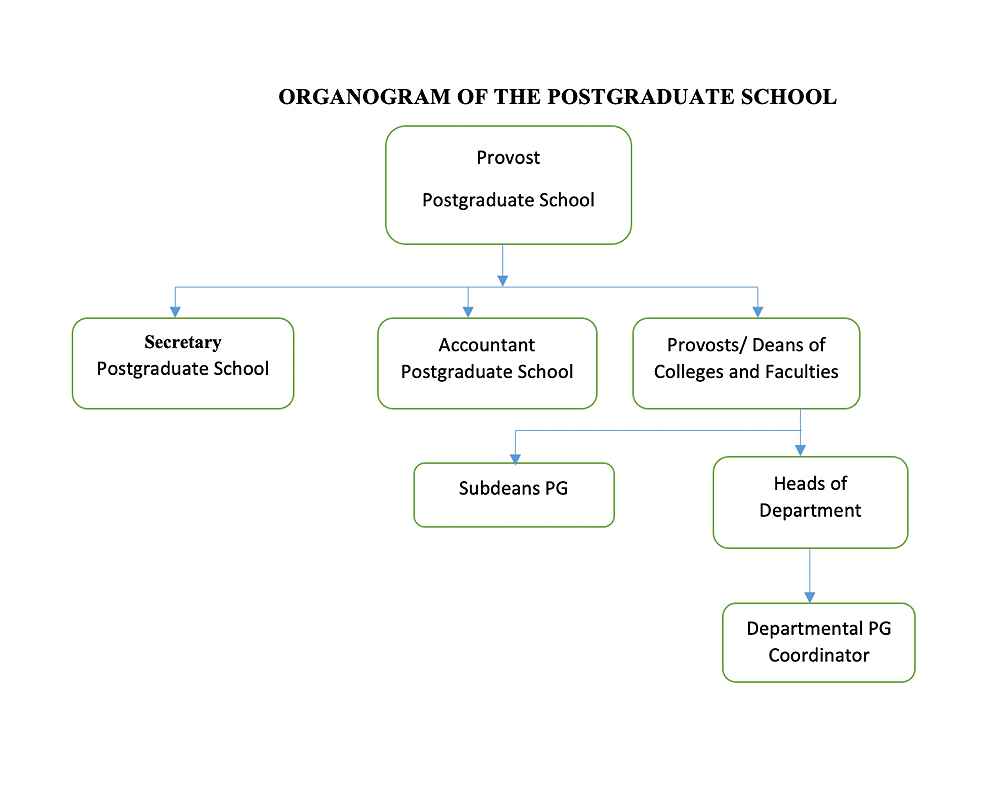
Organogram
Professor Russell Olukayode Christopher SOMOYE
Russell Olukayode Christopher SOMOYE is a professor. He holds a B.Sc. (Mathematics), M.Sc.(Economics.), and Ph.D. (Finance & Entrepreneurship) from University of the West of Scotland. He also holds Cert. (Computer Science), Manchester University, Cert.(System Analysis and Design) Manchester Polytechnic. Prof. Somoye also attended short courses and obtained Cert. (Financial Management), Oxford University, Cert.(Leadership & Entrepreneurship), Oxford University, Cert.(Entrepreneurship), Harvard Business School, Cert.(Taxation Accounting) London, Cert.(Project Analysis) World Bank, among other qualifications.
Professionally. Prof. Somoye is a Fellow of the Chartered Institute of Bankers of Nigeria (CIBN), Associate Member, Chartered Institute of Stockbrokers of Nigeria (CIS), Chartered Institute of Taxation of Nigeria(CITN), and National Accountants of Nigeria(ANAN), among others.
Prof. Somoye was the Head of Departments of Accounting and Banking, Industrial Relations and Personnel Management and Cooperatives and Rural Development, Director of Centre for Sandwhich Programmes (CESAP); Chairman, Board of Survey, and Dean, Faculty of Social & Management Sciences as well as that of the Faculty of Administration and Management Sciences, Olabisi Onabanjo University, among others. He is currently the Provost of Postgraduate School of Olabisi Onabanjo University, Ago-Iwoye and a member of the Governing Council of Olabisi Onabanjo University, Ago-Iwoye.
Prof. Somoye teaches accounting, entrepreneurship, finance and banking at both undergraduate and postgraduate levels at Onabanjo University, Ago-Iwoye, Ogun State, Nigeria. He has supervised several undergraduates students projects. He has also supervised dissertations and theses of postgraduate students including 12 PhD Students, in Entrepreneurship, Accounting and Finance. He has over 93 publications, covering journal articles, monographs, and books to his credit. He is also an author of a chapter in a book on Decolonising Entrepreneurship being edited by Swansea University, United Kingdom. He is an editor to many local and international journals. He serves as an examiner to many universities locally and internationally.
Prof. Somoye was a consultant to the Wold Bank and the Central Bank of Nigeria. He is currently a member of the Research Group of the Chartered Institute of Bankers of Nigeria (CIBN) and a public commentator on finance, banking, entrepreneurship, and economic issues for sustainable development.
Contact Information
- Address: Postgraduate School, Main Campus.
- Email: pgschool@oouagoiwoye.edu.ng, provostpgs@oouagoiwoye.edu.ng
- Application portal: pgs.oou.ed.ng/portal/application/apply.php
Colleges and Faculties
Recent Posts
- OOU TO GRADUATE 147 FIRST CLASS STUDENTS, OTHERS AT 35TH CONVOCATION CEREMONIES January 22, 2026
- CONVOCATION CEREMONIES COMMENCE ON THURSDAY, 22ND JANUARY January 21, 2026
- PRO-CHANCELLOR’S END-OF-YEAR MESSAGE AND BEST WISHES FOR 2026 TO THE UNIVERSITY COMMUNITY December 31, 2025
- DON SEEKS SOLUTION TO NIGERIA’S POWER GRID CHALLENGES December 3, 2025
- OOU STUDENTS EMERGE WINNERS OF CIPM NATIONAL QUIZ COMPETITION December 3, 2025