

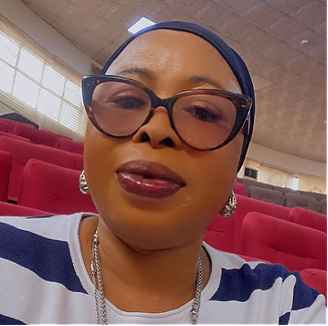
 Dr Muinat Moronke Adeyanju
mmadeyanju@oouagoiwoye.edu.ng
https://orcid.org/0000-0002-6383-3275
Google Scholar Citation: 252; h-index: 9; i10-index:9
+2348067191759
Dr Muinat Moronke Adeyanju (née Alli) is a respected Nigerian academic, researcher, and mentor with over two decades of distinguished service in the field of Biochemistry. Currently a Reader in the Department of Biochemistry, Faculty of Basic Medical Sciences, Olabisi Onabanjo University (OOU), Ago-Iwoye, she has established herself as a passionate teacher, prolific researcher, and effective administrator. Her work spans enzymology, nutrition, proteomics, fermentation technology, and biomedical biochemistry, with particular focus on diseases of public health concern such as diabetes, cardiovascular disorders, and malnutrition.
Her approach to teaching integrates theory with application, ensuring that students not only master concepts but also understand their real-world implications in medicine, nutrition, forensics and biotechnology. She also actively mentors students through supervision of research projects, guidance in industrial placements (SIWES), and moral and professional counseling. Many of her mentees have gone on to build careers in academia, industry, and public health.
A hallmark of Dr. Adeyanju’s career is her research productivity. Her investigations address pressing health and nutritional challenges through biochemical inquiry which embodies translational relevance, bridging traditional food knowledge with biochemical innovation to solve global health concerns.
Her career exemplifies the integration of teaching excellence, impactful research, visionary leadership, and community service. With over 23 years of experience, more than 30 publications, and leadership roles within her department and faculty, she continues to contribute meaningfully to science and society.
Her ongoing research on enzyme biotechnology and food innovation, as well as her administrative leadership in quality assurance and Forensic Science, points to an even more influential role in shaping biochemistry, forensics and higher education in Nigeria and beyond.
Recent Publications
- Martinez, B., Catelli, L., Romero, M., Okolie,V. O., Keshinro, S.O, Carvalho, E. F., Vullo, C., Gusmão, L. (2017). Forensic evaluation of 27 y-str haplotypes in a population sample from Nigeria. Forensic Science International: Genetics Supplement Series 6; 289–291.
- Oluwakuyide, R.T. and Keshinro, S. O. (2017).Challenges in the identification of exhumed skeletonised human remains of a child: A case report. Forensic Science International: 21st Triennial Meeting of The International-Association-of-Forensic-Sciences (IAFS); 277:196-1.
- Martínez, B. Nguidi, M. Catelli, L., Vullo, C., Okolie, V.O., Keshinro, S.O., Carvalho, E. F. Gusmão, L. and Simão, F. (2019). Mitochondrial genetic profile of the Yoruba population from Nigeria. Forensic Science International: Genetics Supplement Series, № 1, p. 807-809.
10.1016/j.fsigss.2019.10.185 - Owolabi, S., Salihub, L., Olaitan, I., Adeyanju, M.M., Keshiro, S. O. Forensic analysis of projectile for the identification of firearm used in criminal cases: A Trace Evidence (manuscript under preparation)
Academic Staff
Dr. Samuel O. Keshinro- Senior Lecturer, Pathologist (Adjunct) samuel.keshinro@oouagoiwoye.edu.ng; Orchid number-0000-0002-8853-8395 Google scholar citation – https://scholar.google.com/citations?hl=en&user=ifjN-vAAAAAJ (+234 802 358 3889)
Mr. Sikiru Owolabi- Assistant Lecturer
sikiru.owolabi@oouagoiwoye.edu.ng
Orchid number: 0009-0000-9587-3047 Google scholar citation:
https://scholar.google.com/citations?view_op=new_articles&hl=en&imq=Sikiru+Owolabi&authuser=1# (+234 803 625 1207)
Miss Ifeoluwa Olaitan-Assistant Lecturer: ifeoluwa.olaitan@ oouagoiwoye.edu.ng Orchid number: 0009-0006-3350-4995 Google scholar citation: https://scholar.google.com/citations?user=y2VelXwAAAAJ&hl=en (+234 706 884 4250)